Updated after Anthropic's Claude disclosure
How to Remove AI Text Watermarks in 2026
Choose NoLLMWM for careful hidden-character cleanup in a browser. Choose watermarks-remover for a stronger local technical workflow. Choose Claude Text Lab when factual checks matter during regeneration. For Claude's statistical watermark, character deletion alone does not target the signal.
Updated 09.2026
Claude uses a keyed version of SynthID-Text
Anthropic says Claude's mark is a statistical pattern spread across token choices. It is not a string of invisible characters placed between words. Removing zero-width spaces still helps with text hygiene, but it does not change Claude's original word sequence. One studied method for this kind of mark biases a secret "green list" of favored tokens at each step, though Claude's exact key and thresholds stay unpublished. Anthropic ties the rollout to Article 50 of the EU AI Act, which requires providers to mark AI output and deployers to disclose certain public-interest text, with fines up to 15 million euros or 3 percent of global turnover.
Practical result: use a character cleaner for hidden Unicode. Use a rewrite process when your task involves a statistical signal. No third-party tool in this comparison has Anthropic's private detector or secret key.
Read Anthropic's technical explanationStart with the operation, not the brand
Two tasks are sold under the same label. Pick the task first.
Clean hidden characters
Find and remove selected Unicode characters without replacing the visible words.
- Best for copied text and formatting cleanup
- Meaning normally stays intact
- Does not target Claude's statistical mark
Rewrite the wording
Replace words and sentence patterns to change a statistical signal stored across token choices.
- Targets the relevant layer for SynthID-style marks
- Changes prose and sometimes structure
- Requires fact, tone, link, and quote review
Compare the seven tools
Filter by the job you need to complete. Select All to restore the full comparison.
| Tool | Main action | Processing | Changes words | Best fit |
|---|---|---|---|---|
| watermarks-remover | Unicode inspection, cleanup, optional rewrite hooks | Local, open source | No in cleanup mode | Reports, automation, repeatable work |
| Claude Text Lab | Sanitation, fact ledger, regeneration audit | Local-first, separate model for rewrite | Only in regeneration mode | Fact-sensitive editorial work |
| Unmark Text | Invisible Unicode inspection and removal | Browser-local | No | Fast checks of common hidden characters |
| HumanText | Public cleaner plus separate humanizer | Browser cleaner and server rewrite | Only in humanizer | One brand for cleanup and rewriting |
| Rephrasy | Token rewriting and AI detection | Paid online service | Yes | Commercial rewrite workflow and API |
| NoLLMWM | Selective cleanup plus optional rewrite | Local scan, online rewrite | Only in rewrite mode | Careful cleanup with context warnings |
| RemoveAITextWatermark.app | Reasoning-based rewrite | Online, no signup advertised | Yes | Quick rewrite with low setup burden |
Seven tools, seven different jobs
Each card states what the product does, where it fits, and the main limit found in this review.
Selective browser cleaner
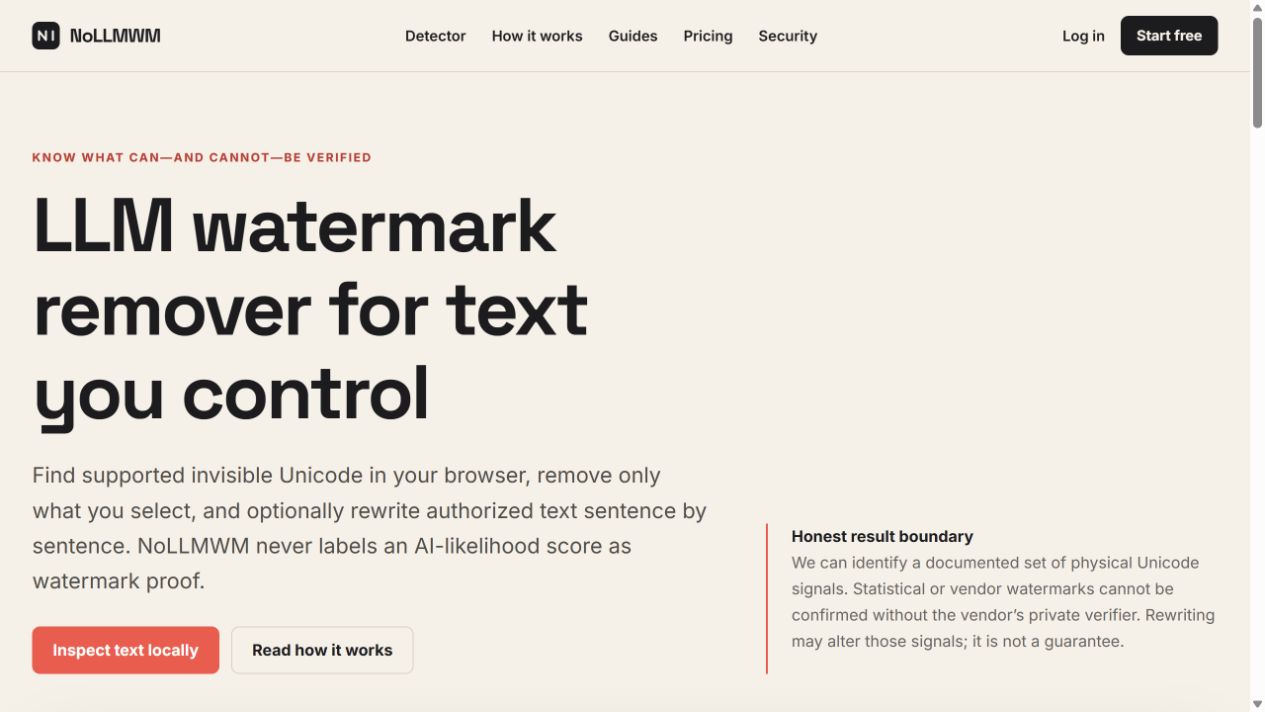
NoLLMWM
The most careful browser-cleaning result in our fixture. Low-risk removals are selected by default, while sensitive characters remain available for review.
- Processing
- Local browser scan. Online rewrite is separate.
- Best for
- Emoji, multilingual writing, and editors who want context before removal.
- Main limit
- Narrower default coverage. Two unusual spaces were not listed or normalized.
Open NoLLMWMPreserved the emoji joiner, Persian non-joiner, and variation selector. The clean control stayed byte-identical.
Local technical toolkit
watermarks-remover
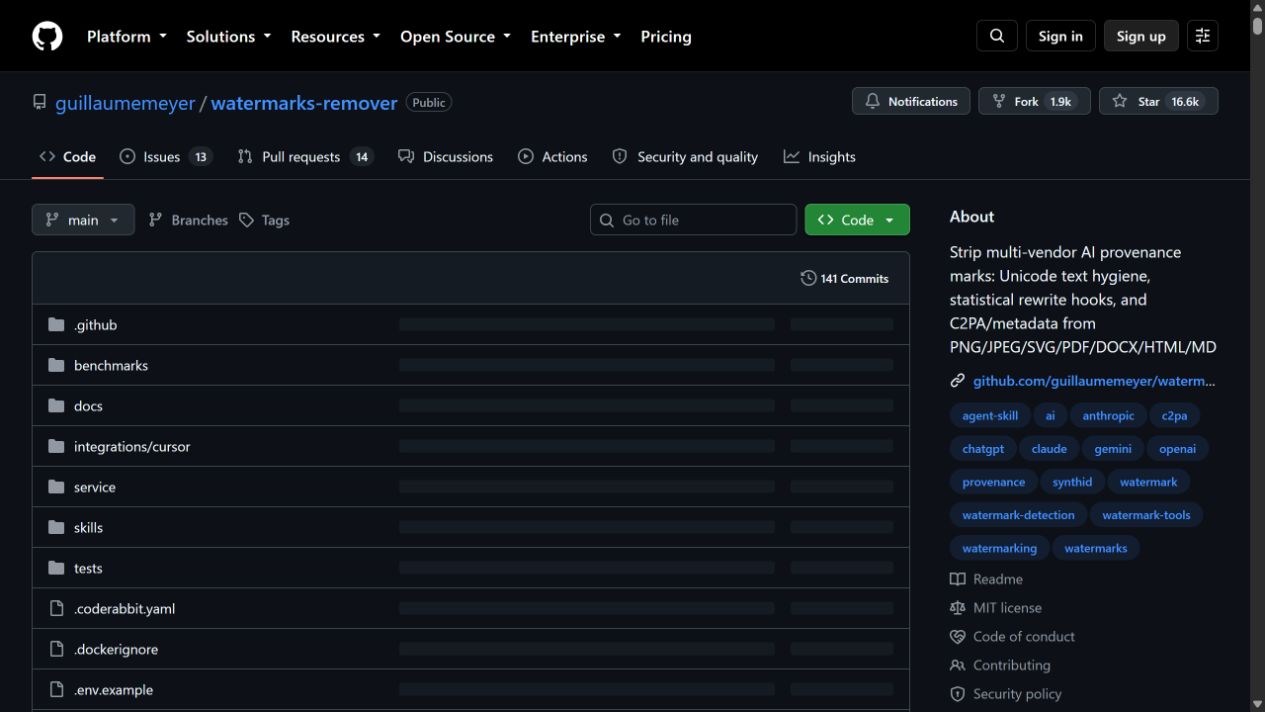
The broadest technical toolkit in the comparison. Version 0.5.0 separates inspectable Unicode cleanup from optional wording changes and produces useful reports.
Why it stands out
watermarks-remover is built for repeatable work rather than a single paste box. The repository combines a command-line interface, service components, file support, reports, optional rewrite hooks, and research benchmark material. Its clearest strength is the separation between deterministic character cleanup and wording changes.
Our fixture produced nine reported suspicious items. The default cleaner removed six characters, normalized two unusual spaces, and preserved a left-to-right mark. It also preserved the three legitimate controls. Both runs produced matching output hashes. That consistency gives technical teams a result they can inspect and reproduce.
- Processing
- Local open-source command line and service components.
- Best for
- Developers, quality teams, automation, and repeatable publishing checks.
- Main limit
- More setup than a paste-and-clean website.
View the repositoryRemoved six target characters, normalized two unusual spaces, and preserved all three legitimate controls.
Fact-focused regeneration
Claude Text Lab
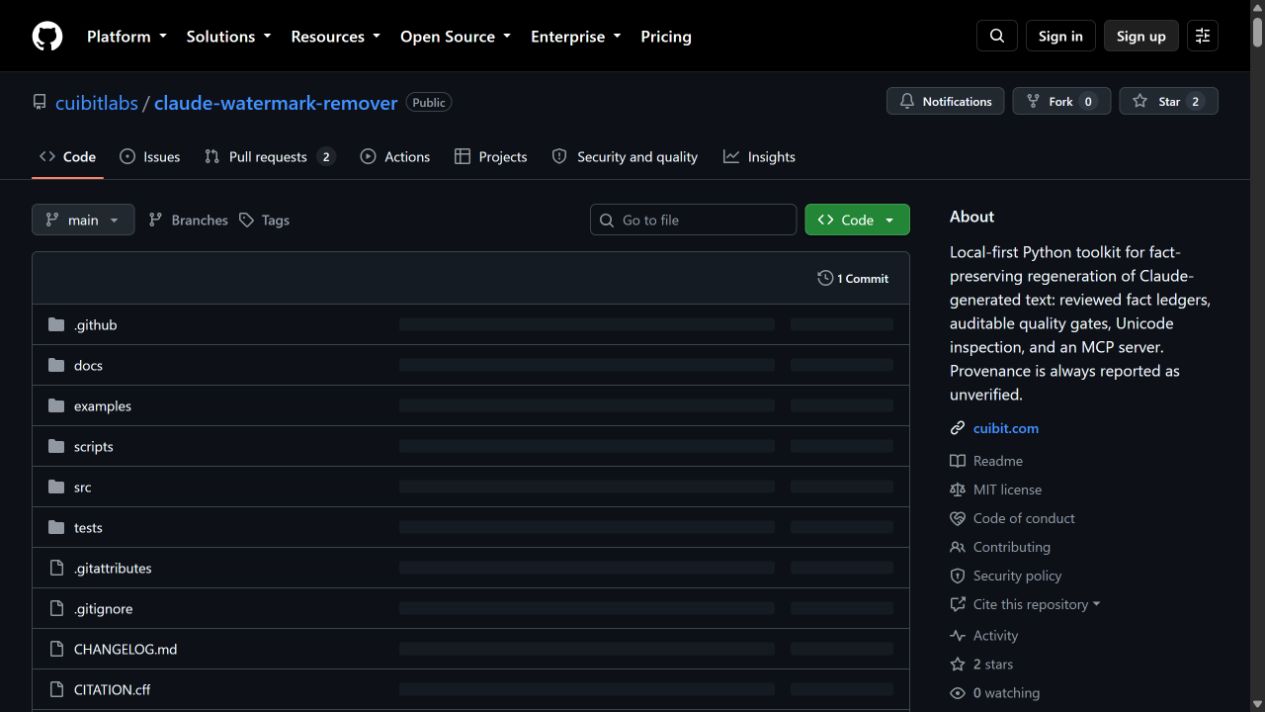
A local-first workflow built around a fact ledger, exact-value checks, phrase-overlap checks, and a final audit.
Why it stands out
Claude Text Lab addresses the main editorial risk of rewriting: a polished sentence which changes a date, quantity, negation, or level of uncertainty. The workflow extracts a structured fact record, reviews it, asks a non-Claude model to write fresh prose, then checks exact values, factual coverage, unsupported additions, length, and phrase overlap.
We ran the source-tree test suite and deterministic sanitation path. Sixty-eight tests passed, thirteen optional integration tests were skipped, and no test failed. Sanitation handled all nine target classes while preserving the emoji joiner, Persian non-joiner, and variation selector. The full regeneration path was not exercised.
- Processing
- Local sanitation. Regeneration needs a compatible non-Claude model.
- Best for
- Facts, figures, technical prose, and structured editorial review.
- Main limit
- The full model-based regeneration path was not tested in this comparison.
View Claude Text LabSixty-eight tests passed. Thirteen optional integration tests were skipped. No test failed.
Simple character interface
Unmark Text
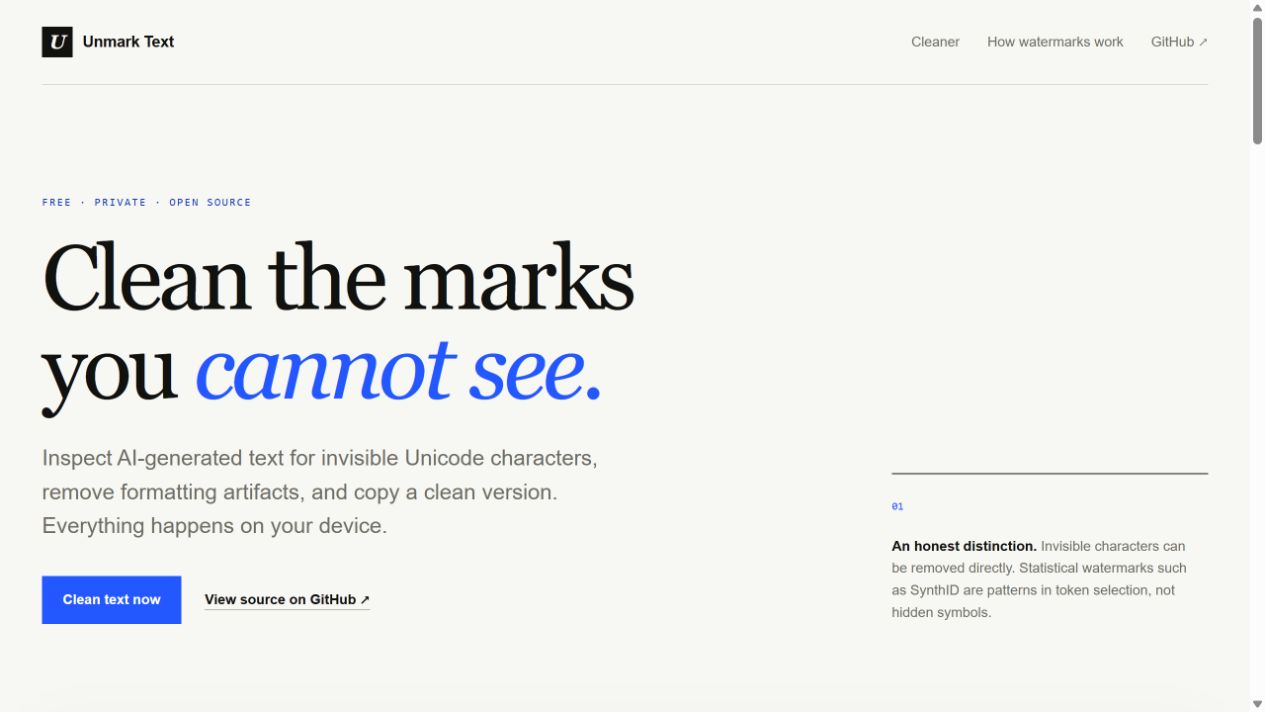
A direct way to inspect common invisible Unicode characters, review code points, and clean pasted text inside the browser.
Why it stands out
Unmark Text makes character inspection easy to understand. Paste text, inspect the reported code points and counts, then copy the cleaned version. The interface suits someone who wants evidence of the exact hidden characters instead of a vague claim about watermark removal.
Our fixture exposed the cost of its broad cleanup. The tool found eight named cases and normalized two unusual spaces, but it missed a Unicode tag. It also removed the emoji joiner and Persian non-joiner even though both were intentional. The variation selector remained intact.
- Processing
- Browser-local interface with no account advertised.
- Best for
- Quick checks of ordinary English text.
- Main limit
- Removed an intentional emoji joiner and Persian non-joiner in the fixture.
Open Unmark TextFound eight named cases and normalized two unusual spaces. A Unicode tag was missed.
Cleaner and humanizer
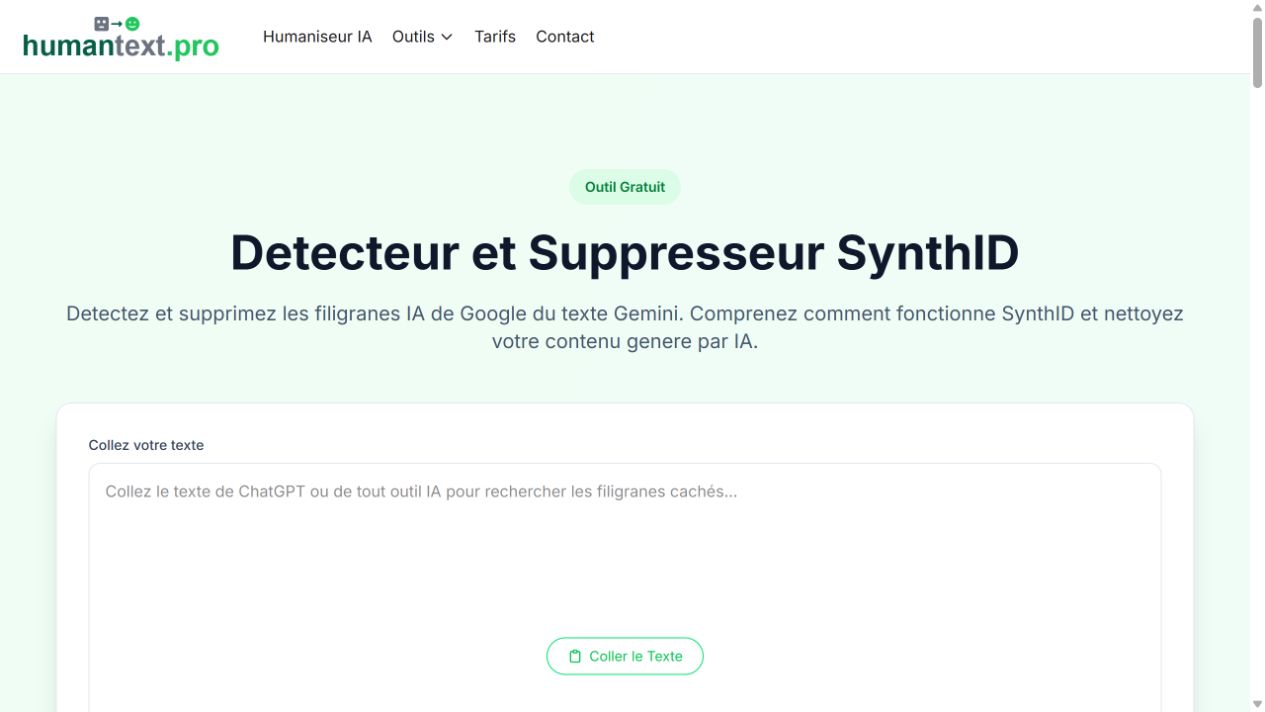
HumanText
A public character cleaner and a separate server-side humanizer under one product family.
Why it stands out
HumanText puts two distinct operations under one brand. Its public cleaner targets hidden characters and formatting. Its humanizer rewrites text through a separate server process. The product page also states statistical SynthID requires rewriting rather than character deletion, which is an important distinction.
The cleaner was the most aggressive path in our fixture. It reported eleven hidden findings, removed all three legitimate controls, normalized spaces, changed curly quotes to straight quotes, and left a Unicode tag in place. A displayed 99% AI likelihood was a separate style-detection result, not proof of a watermark.
- Processing
- Public web cleaner. Separate server-based rewrite service.
- Best for
- Users who prefer one site for cleanup and optional rewriting.
- Main limit
- Aggressive cleanup changed legitimate controls and typography in the fixture.
Open HumanTextRemoved all three legitimate controls, normalized spaces, and changed curly quotes to straight quotes.
Commercial rewrite service
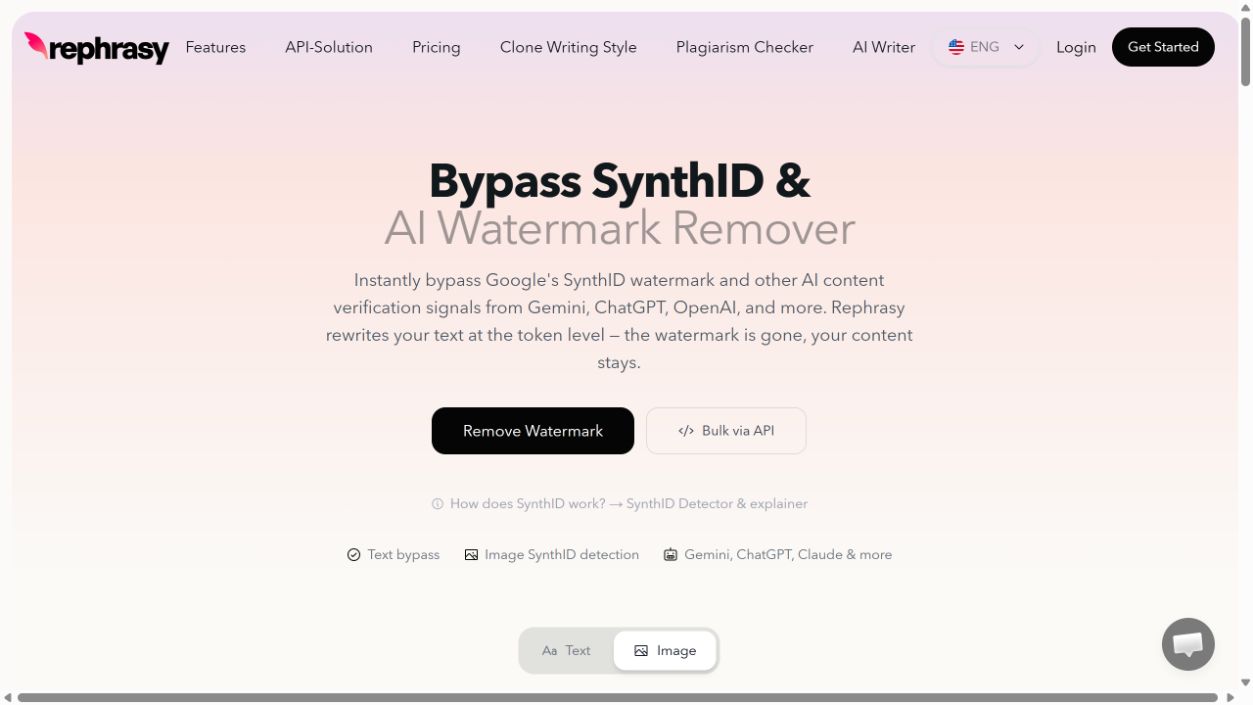
Rephrasy SynthID Bypass
A paid, rewrite-led product paired with AI detection, humanization, and API offers.
Why it stands out
Rephrasy targets the relevant layer for a statistical watermark by changing token and sentence choices. The commercial package combines rewriting, AI detection, humanization, passes, subscription plans, and API access. This makes the offer broader than a simple hidden-character utility.
The same product page acknowledges third parties do not hold Google's private key for direct SynthID confirmation. That limitation matters even more for Claude's private setup. We opened the interface but did not submit the fixture, so this comparison has no measured result for factual preservation, writing quality, or a watermark score.
- Processing
- Server-side rewriting through a commercial web service.
- Best for
- Users who want a paid workflow and API options.
- Main limit
- The policy describes storage and third-party APIs without a fixed deletion period.
Open RephrasyThe interface was opened, but the fixture was not submitted. No meaning or rewrite-quality score was produced.
No-signup web rewrite
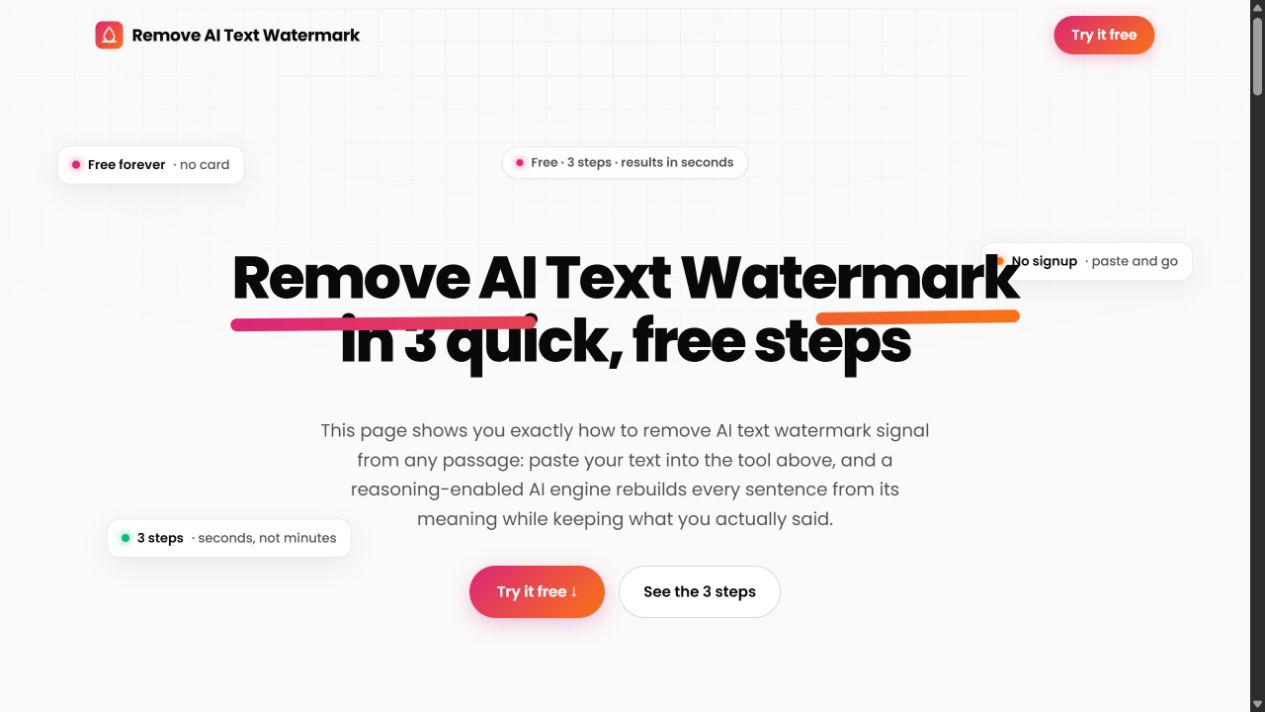
RemoveAITextWatermark.app
A low-friction reasoning-based rewrite interface for longer passages, with no signup or payment advertised.
Why it stands out
RemoveAITextWatermark.app has the clearest low-friction proposition in the rewrite group. The product page advertises no signup, no payment, and a 30,000-character input. The service focuses on producing new wording rather than inspecting hidden Unicode.
The simplicity comes with limited visibility. The admitted sources describe a proprietary reasoning-enabled system but do not identify the model, retention period, or full data path. The terms avoid guarantees for detector or watermark-verification results. We did not submit the fixture, so output quality and factual preservation remain unmeasured.
- Processing
- Proprietary server-side rewrite.
- Best for
- Quick web rewriting with a stated 30,000-character limit.
- Main limit
- The admitted sources do not explain the model, retention period, or full data path.
Open RemoveAITextWatermark.appThe fixture was not submitted. Factual preservation and output quality were not measured.
Why the two layers need different tools
One layer lives between characters. The other is spread across word choices.
Character layer
Invisible Unicode
A scanner lists exact characters, positions, and replacements. The visible sentence usually stays the same.
Use inspection and selective cleanup.
Token layer
Statistical watermark
The signal depends on choices made during generation. Character deletion leaves those choices in place.
Use rewriting, then check every fact.
Choose by use case
Use the narrowest operation which solves the real problem.
Minimal character changes
Start with NoLLMWM. Its default choices preserved the legitimate controls in our fixture. Pick watermarks-remover for broader coverage and reports.
Keep text on your device
Use watermarks-remover for local automation or Claude Text Lab for local sanitation and a structured factual process.
Preserve facts during rewriting
Use Claude Text Lab. Its fact ledger and exact-value rules target dates, figures, unsupported additions, and phrase overlap.
Simple web rewrite
RemoveAITextWatermark.app advertises the lowest setup burden. Rephrasy offers a broader paid package and API.
One site for both paths
HumanText combines a public cleaner and a separate humanizer. Compare the cleaned output closely with the source.
Research configuration
watermarks-remover includes benchmark material for a disclosed SynthID-style setup. Results apply only to the tested configuration.
How this comparison was tested
The test answers character-cleaning questions. It does not rank rewrite quality.
We used two original English fixtures. The mixed fixture contained 258 words, nine suspicious Unicode cases, and three legitimate controls: an emoji joiner, a Persian non-joiner, and a variation selector. The clean control contained only those three legitimate cases. Each available cleaning path ran twice. We compared hashes, removals, preservation, and changes to the clean text.
No text was sent to an online rewrite service. We also skipped a large local model. Rewrite features are described from the selected product sources, with no measured quality or statistical-removal score.
What no public tool proves
Anthropic has not published Claude's operational detector, secret key, thresholds, error rates, or minimum reliable passage length. A third-party rewrite result is not confirmation from Anthropic's detector.
A lower AI-detector score does not prove human authorship. A research result under a known key does not establish performance against Claude or Gemini production settings.
Text length, mixed authorship, and editing all affect the amount of statistical evidence. Short passages carry less signal.
NeurIPS combined a Pangram score with added human review across 969 position paper submissions in 2026, then issued 178 outright rejections and requested proof of human involvement in 123 more. The score triggered a process, not a verdict.
A signal's category matters too. C2PA Content Credentials verify a file's signed history through cryptography, not through word choices, and a stylometric detector scores writing patterns without ever touching a key. Neither result confirms Anthropic's specific watermark.
Protect the text, not only the score
Before cleanup
Save the original. Review emoji, multilingual scripts, direction controls, typography, and formatting before accepting removals.
Before an online rewrite
Avoid confidential client work, personal data, unpublished contracts, or protected records until you have reviewed the current privacy policy.
Before publication
Compare names, numbers, dates, links, quotations, uncertainty, and negation. Removing a signal does not cancel disclosure duties from a school, employer, contract, or platform.
Frequently asked questions
What is an AI text watermark?
The phrase often refers to hidden Unicode characters or a statistical pattern in word selection. These forms need different tools. A Unicode cleaner removes character-level artifacts. A rewrite changes words and sentence structure.
Does removing hidden characters remove SynthID?
No. SynthID Text works through token choices during generation. Removing zero-width spaces or special formatting does not change those choices. Hidden-character cleanup still helps with copied text, broken formatting, search indexing, and publishing hygiene.
Does Claude use SynthID-Text?
Yes. In August 2026, Anthropic explained Claude uses a keyed version of the SynthID-Text approach. The public explanation does not include its operational detector, secret key, or decision thresholds.
Does copy and paste remove an AI watermark?
Copy and paste sometimes drops formatting or selected hidden characters. The visible words usually stay in the same order. It does not target a statistical signal stored across those word choices.
Do AI watermark removers change meaning?
Character cleaners normally leave visible wording alone, though aggressive removal might affect emoji, multilingual scripts, or text direction. Rewrite services replace wording and sometimes structure. Review every fact, number, name, link, quotation, and qualification.
Are general AI detectors reliable?
Not consistently. OpenAI withdrew its own AI-text classifier in 2023 after measuring only 26% accuracy and a 9% false-positive rate on human writing. A peer-reviewed 2023 study found detectors from the same period flagged 61.22% of human-written TOEFL essays by non-native speakers as AI-generated. These figures are dated and tool-specific, but they show why a single score should never replace a documented process.
Are AI text watermark removers legal?
The category has legitimate uses, including text cleanup, accessibility checks, privacy review, formatting repair, and editorial quality control. Rules depend on the text, jurisdiction, contract, school, employer, or platform. In the EU, the AI Act requires providers like Anthropic to label AI output, but it does not stop independent developers from building removal tools.
Core sources
Public links used for the current mechanism and selected tools.
Final check
Choose the operation before you choose the tool.
Inspect the source, run the narrowest useful change, and compare the output with the original.
Why it stands out
NoLLMWM treats invisible characters as editorial decisions. The result screen shows the code point, its position, nearby text, and a warning. In our mixed fixture, the scanner supported seven physical signals but preselected only the isolated zero-width space and Unicode tag. Word joiner, soft hyphen, direction controls, and the left-to-right mark stayed available for manual review.
This conservative approach matters when text contains emoji or non-Latin scripts. The tool recognized the emoji joiner, Persian non-joiner, and variation selector as legitimate. The clean control received no warning and remained byte-identical. The tradeoff is narrower coverage. Two unusual spaces passed through unchanged.